
Solid vs Engineered Hardwood Flooring: Which Is Right for Your Home?
· By Dionatha Soares
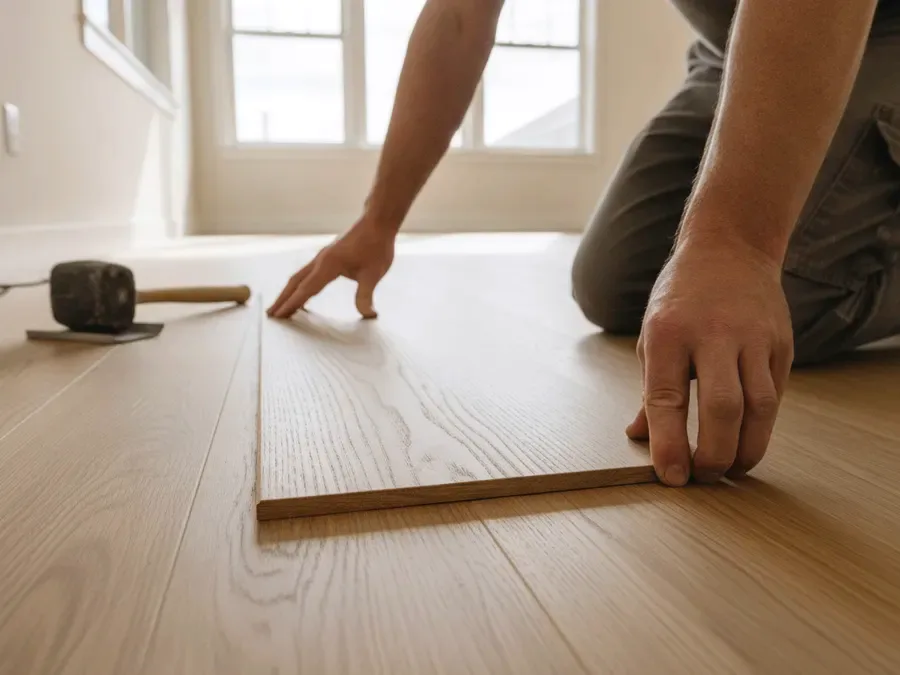
Solid and engineered hardwood are both real wood floors, and once installed they can look nearly identical. The difference is in how they are built, and that changes where each one performs best, how they handle moisture, and how many times they can be refinished.
This guide breaks down the honest trade-offs so you can pick the right product for your rooms, your subfloor, and your budget. There is no single winner. The best choice depends on where the floor is going.
How they are built
Solid hardwood is exactly what it sounds like: each board is a single, solid piece of wood, typically three-quarters of an inch thick. Because it is all wood, it can be sanded and refinished many times across its life.
Engineered hardwood has a real wood top layer, called the wear layer, bonded over several cross-layered plies of wood underneath. That layered core makes it far more dimensionally stable, meaning it swells and shrinks less as humidity changes.
Moisture and where each one belongs
The layered construction of engineered hardwood gives it a real advantage in spaces prone to humidity swings, including basements, floors over concrete slabs, and rooms with radiant heat. Solid wood in those conditions is more likely to cup or gap.
Solid hardwood is at its best on above-grade floors over a wood subfloor, which describes most main and upper levels in New England homes. In those rooms it is a classic choice that lasts for generations.
Refinishing and lifespan
This is the biggest practical difference. Solid hardwood can be refinished multiple times, so a good floor can be brought back to new-looking condition again and again over decades. That makes it the long-game choice for a forever home.
Engineered hardwood can also be refinished, but only if its wear layer is thick enough, and only a limited number of times. A quality engineered floor with a thick wear layer might refinish once or twice; a thin wear layer may only allow a light screen-and-recoat.
Installation and cost
Engineered planks are often easier to install over more subfloor types and can sometimes float, which can lower installation cost and time. Solid hardwood is nailed or stapled to a wood subfloor and needs more acclimation time before installation.
On price, the two overlap heavily. A premium engineered floor with a thick wear layer can cost as much as solid hardwood, while budget engineered products cost less. Long term, solid wood often wins on value because of how many times it can be renewed.
How to decide for your home
Start with the room. Going over a slab, in a basement, or with radiant heat leans engineered. An above-grade living area over a wood subfloor, where you want maximum lifespan, leans solid. If you plan to stay for decades, solid wood usually pays off; if you want stability in a tricky space, engineered earns its keep.
The right answer often comes down to your specific subfloor and where the floor is going. We look at both and recommend the product that will actually last in your Plymouth or South Shore home, rather than pushing one over the other.
Frequently asked questions
- Can engineered hardwood be refinished?
- Yes, if the wear layer is thick enough. A quality engineered floor might refinish once or twice, while a thin wear layer may only allow a light screen-and-recoat rather than a full sanding.
- Is solid or engineered better over concrete?
- Engineered hardwood is the better choice over a concrete slab or in basements, because its layered core stays more stable through humidity changes. Solid wood in those spots is more likely to cup or gap.
- Which one lasts longer?
- Solid hardwood typically lasts longer because it can be refinished many times over decades. Engineered floors last a long time too, but their refinishing life is limited by the wear layer thickness.
- Which should I choose for my home?
- It depends on the room and subfloor. Book a free in-home estimate and we will look at where the floor is going and recommend the product that will hold up best for your space.
Related services
Serving
Found this helpful? Make us a preferred source on Google.
Ready for an exact price?
Get a free, no-pressure in-home estimate. Real numbers for your home, not a phone guess.