
Refinishing vs Replacing Hardwood Floors: How to Know Which You Need
· By Dionatha Soares
When hardwood floors start to look worn, homeowners often assume the only fix is a full replacement. In many cases that is not true. Solid hardwood can be sanded and refinished several times over its life, so the tired floor you are ready to rip out may just need a fresh surface.
This guide covers the signs that point to refinishing, the ones that point to replacement, and the gray-area cases where a hands-on look is the only way to decide. Getting this call right saves money and keeps the original character of your home.
When refinishing is the right call
Refinishing works when the boards themselves are structurally sound and still have enough wood above the tongue to sand. If your floor has surface scratches, dull or worn finish, light water rings, or a color you no longer like, those are all cosmetic problems that sanding and a new finish will solve.
Solid hardwood can usually be refinished multiple times across its life. Engineered hardwood can be refinished too, but only if it has a thick enough wear layer, which is why species and construction matter to the decision.
When replacement is the smarter move
Replacement makes sense when the wood has run out of life or has been damaged beyond what sanding can fix. Boards that have already been refinished so many times that the tongue is exposed cannot take another pass. Deep rot, active subfloor moisture, and widespread cupping or crowning also point toward replacement.
You might also choose to replace floors that are perfectly sandable if you want a different species, a wider plank, or a completely different layout. In that case it is a design decision, not a condition problem.
How to test the thickness yourself
You can get a rough read on remaining thickness at a floor vent or a threshold where the edge of a board is exposed. If there is a solid layer of wood above the tongue-and-groove joint, there is likely room to sand. If the top has worn down close to the joint, the floor may be at the end of its refinishing life.
This is only a rough check. Old floors settle unevenly, and a single spot does not always represent the whole room, so treat it as a starting point rather than a final answer.
The gray-area cases
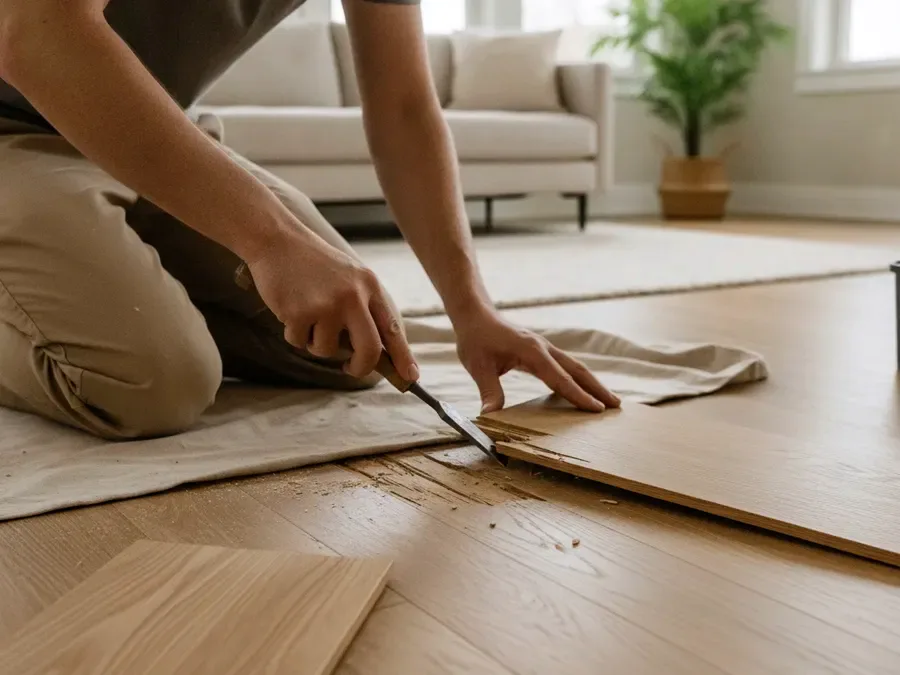
Some floors sit right on the fence. A room with a few damaged boards near a leak, or an older floor with scattered thin spots, can often be repaired and refinished by swapping the bad boards and blending the new wood into the old. This board-by-board repair is far cheaper than replacing the whole floor.
Water damage is the classic gray area. A floor that got wet once and dried without cupping usually refinishes fine. A floor sitting over a slow, ongoing leak needs the source fixed first, and only then can anyone judge whether the wood is salvageable.
Getting a straight answer
The honest answer for most homes comes from someone standing on the floor, checking board thickness at the edges, tapping for soft spots, and reading the moisture in the subfloor. Photos and phone descriptions only go so far.
Across Plymouth, Marshfield, and the South Shore, we look at the floor, measure what is left, and tell you plainly whether refinishing will hold up or whether replacement is the better spend. There is no upside for us in recommending more work than your floor needs.
Frequently asked questions
- How many times can hardwood be refinished?
- Solid hardwood can usually be sanded and refinished several times across its life, depending on the original board thickness and how aggressively it was sanded each time. Engineered wood depends on the thickness of its wear layer.
- Can water-damaged floors be refinished?
- Sometimes. A floor that got wet once and dried flat often refinishes fine. A floor that cupped, crowned, or sits over an ongoing leak usually needs board replacement or repair first, and the moisture source must be fixed.
- Is it worth refinishing an old floor?
- Usually yes. Refinishing costs far less than replacement and preserves the character of an older home, as long as the boards are sound and have enough wood left to sand.
- How do I know which one my floor needs?
- Book a free in-home estimate. We check board thickness, soft spots, and subfloor moisture in person, then tell you plainly whether refinishing or replacement is the better call.
Found this helpful? Make us a preferred source on Google.
Ready for an exact price?
Get a free, no-pressure in-home estimate. Real numbers for your home, not a phone guess.